Wednesday, January 13, 2010

Number 10 - SILENT LIGHT

Well, I belong to the school of thought that believes a decade is 1-10. So, since we're in the 10th year, I will begin with my top films of the decade. I'll count down and it'll probably take me a long time to finally get to my number one film of the decade, but it'll be worth it.

I start this list with SILENT LIGHT, by Carlos Reygadas.
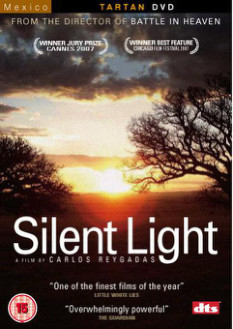


At first glance, I didn't quite know what to make of the film - it's slow moving and very artistic. The story follows a deeply religious Mennonite family but focuses upon the actions and reactions of three people: the husband, Johann, his wife, Esther, and his mistress, Marianne. It's clear that Johann loves his wife and family but he's truly drawn to Esther and feels as though she is his better match and truer love. Johann is tormented with falling in love with Marianne because he doesn't want to hurt Esther, whom he's been completely forthcoming with about the affair, but cannot stand the thought of losing either women.

The film brings to light the dilemma lots of people must face in life: Passion verses Duty. Johann and Esther are in a passionless marriage with seven fair-headed children. It's obvious they love each other and their children. They've made a commitment, under God, and Johann sees it as his duty to remain married to Esther and provide their children with the best life possible. Esther is very much aware of Marianne and the affair and suffers in silence as it is her duty to be the best wife and mother she can be - no matter the circumstances. Their stoicism is painful - to watch and for them to live.

But when Johann is with Marianne, he is filled with passion. The chemistry between the two is apparent and energized. Marianne is also tormented because she's in love with Johann yet knows that they will never be together. She also feels sad for Esther because she knows that even though Johann fulfills his husbandly duties with Esther, the fire in his heart burns for her.

I have to say that I honestly didn't like Johann that much. I felt his "honesty" to be brutal and careless. I cared much more for Esther and Marianne, which I finally decided that the story was about anyway. Both of these women were in love with this one man - who couldn't fully give himself to either one of them. They were both settling. I don't know who was more flawed, or even if one was more flawed than the other(s).

The story of this tormented trio is told beautifully with long quite shots that capture the stoic essence of a Mennonite lifestyle. The story does have resolution but I'm not quite sure how I feel about the ending. I think Reygadas employs some supernatural imagery that bothered me at the time. To me, the use of this abrogated the honesty portrayed in the story up to that point. I think the final decision could have still been the same without the use of unnatural happenings. However, this wasn't enough to sway me away from the film.

I recommend watching this film at least three times: Once to take it all in as a whole; Once to follow and contemplate the story and; Once to absorb the visually mesmerizing camera work. Below is the trailer.


I think my next favorite movie of the decade will be a bit more uplifting.

Tuesday, November 10, 2009

Bikers Shouldn't Have It Both Ways!

Lately I've been getting pretty annoyed with people on bicycles, because I think they're taking advantage of their own mobility - in an inconsiderate way. Here's the thing: I usually share the road with three or four people riding bikes on a daily basis and what pisses me off is that they want to act like both a pedestrian and a moving vehicle. I say they shouldn't be able to have it both ways.

Call me a bikest if you want, but I just think they need to choose what they want to be and stick with their choice. For example, they shouldn't be able to ride beside of me on the road and then use the cross walks (as a pedestrian) to make turns, as opposed to following street rules. Does that make any sense? It's law in Georgia that a a driver must stop for pedestrians crossing at crosswalks. But when I see a biker hop on the crosswalk, I think it should be fair game.

H1N1 & Flu Info

I read a fantastic blog from the Freakonomics blog at the New York Times web site. I include everything here as well as the link to the Emory Screening Algorithm which helps you determine if you might have the flu.

From Stephen Dubner's blog:

November 10, 2009, 10:03 am
On the Prevalance of H1N1
By Stephen J. Dubner

In Seattle recently, I met a pulmonologist who said that the H1N1 virus has him busier than he’s ever been, his hospital beds full of flu patients. The uptick hit particularly hard about 10 days ago, he said.

How has the flu been playing out across the country?

Craig Feied, the physician and technologist we write about in SuperFreakonomics (yes, we’ll run a virtual book club session with him soon; he’s in Chapter 2), sent along the following data picture. “Some doctor,” he writes, “made in a few seconds using Amalga.” That’s the hospital software system that Feied and Mark Smith developed at Washington (D.C.) Hospital Center, and which was later acquired by Microsoft.
DESCRIPTION


Here’s Feied’s commentary on the picture:

For anybody who wonders how much “hype” there is in the H1N1 story, here is an Amalga-created graph of flu seasons in Washington, D.C. from 2002 to 2009.

ILI stands for “Influenza-Like-Illness,” meaning that this includes everybody who shows up at the hospital primarily for symptoms of flu (there’s no attempt to confirm the diagnosis of influenza with specific tests, so this likely includes some people with the “common cold” and people with pneumonia or other respiratory infections).

For each year, January 1 is at the left side of the screen and December 31 is at the right. Historically, the “flu season” has a small bump in the fall, with the serious spike usually beginning early in January and extending into the beginning of March.

It’s instantly apparent that this year is unprecedented in recent history. Long before the typical spike season we are already seeing more cases than we’ve ever seen — and presumably the worst is yet to come.

It’s possible, of course, that some of the surge was caused by patients who wouldn’t have gone to an E.R. but for the media “hype,” as Feied puts it, about H1N1.

To that end, Feied offers another data tool: the the Emory screening algorithm — a self-assessed flu survey “to help people decide when it’s time to go to the E.D.,” he says, “versus when they can safely stay home. As this problem reaches disaster proportions, emergency departments and physician offices will need all the help they can get.”

Saturday, October 17, 2009

Philosophical Happiness

Last week while I was in Memphis, I was talking to a friend of mine about happiness. I told him how I always found it kind of amazing that there seemed to be certain people who can shape their world, kind of creating their own reality and maintain a certain amount of happiness in their lives.

For instance, I used to work with a woman who always seemed happy – despite stressors that existed in the office, difficulties she might be experiencing with her kids, unstable romantic relationships and so forth. Regardless of the external strains and pressures on her life, she seemed to carry this sense of constant happiness. (Everyone in the office pretty much thought she was crazy.) Now don’t get me wrong, she got upset about certain things but always recovered pretty quickly. She also had this uncanny ability to turn an unexpected or disappointing result into a result that she decided was probably the better choice anyway. I’ve met several people who are able to do that with outcomes (flip the unwanted result into the better overall result before the affects are realized) and I’ve always found them very intriguing. For some reason, I think men possess and practice this ability more so than women.

Anyway, my friend, Chris, told me about a TED talk he had recently seen about happiness and it was similar to what I was describing. He forwarded me the link. The talk is excellent and the term that describes what I'm talking about is "synthetic happiness." It’s definitely worth the 20 minutes of watching.


While I find the talk philosophically interesting, I don’t know if I completely buy his premise. I think he makes a couple of huge leaps with his conclusions, resulting in fallacious arguments.

For example, his argument about people being happier with fewer options. I don’t know if I truly buy that or not. While someone may have an easier time making a decision between two things verses five things, I don’t think that necessarily translates into happiness. I guess one could argue that the simpler things are, the easier it is to be happy, but again, I just think that’s a huge leap. To me, it makes too many assumptions, the main one being that we are all equal – in the ways we contemplate, seek and achieve happiness. In reality, I don’t think we are all modeled or wired the same way to achieve happiness.

For me, I think I personally have such high expectations for myself that I'm often let down when I fall short. In an order to pull me out of my self-inflicted funk, others tell me that my expectations are too high and if they had achieved what I have, that they'd be ecstatic, and so forth. When I hear that, it doesn't really do much for me, except maybe question that person's own self expectations and wonder if s/he might be a slacker. I know that is a wrong and unfair assumption, which I later discredit, but I'm being honest here. I think it's because I don't believe that synthetic happiness is as good as achieved happiness. It's the whole fake thing that gets me. I don't know how to do it and talk myself into believing it without feeling like a fake, a fraud and a sellout.

Maybe there's more truth in Dan Gilbert's argument but it'd be more about the limited knowledge. For example, if my knowledge is limited, then I have no idea about everything available to me - to help me achieve happiness. The problem is everyone's amount of knowledge is vastly different. A dog is happy because his world is limited, he doesn't have to worry about death and making a difference in the world and performing at his optimal level of dogness. I guess an argument can be made that there are limits within our world and applying the same philosophy should result in the same outcome, but it doesn't make a sound argument.

More thoughts later.

Thursday, October 1, 2009

Today totally blew!

Today has been one of those days where everything seems to go wrong and I end up going a bit crazy because I don't seem to be getting enough oxygen to my brain. Seriously.

I don't know how I'm ever gonna be able to sit back and enjoy life when I keep thinking things should be one way and they're not. I know this sounds absurd and is probably an indication I should be locked in the looney bin, but nonetheless, it's real. Now, note the difference here, I do know there are things I cannot control - that's not my problem. My problem is still wanting them and/or outcomes to be different - this is where the insanity comes into play. So, basically, I cognitively know what my problem is and my limitations but I still get mad anyway. WTF?!

I think the office I work in is contributing to my insanity. First of all, we have no windows to look out of - we're basically dropped into the middle of an art gallery. Now, I like the gallery and the space itself, but it's just not a healthy and pleasant working environment. The gallery changes exhibits every few months and each time they have to do major construction (moving walls, hanging things, etc) and since we're placed in the middle of the gallery, we hear every bit of it, like it's right next door....oh, wait, it is next door. Clients on the phone can hear it too - it's very frustrating. But, a new exhibit is in place and we should be construction free for several more weeks.

Secondly, being a nonprofit totally sucks sometimes. Like most nonprofits, we're always looking for much needed resources (human and fiscal). Our computers are old and we have to piece things together and then things break. It's so inefficient to try and work on old technology. You'd think that with us being a media arts organization, we'd have new technology - Au Contraire, Mon Frere! Today was one of those maddening technology days.

So, tonight I'm gonna try something new - belly dancing. I joined a meetup group and tonight is belly dancing for women. It's only $6 - so I thought I'd give it a shot. I've always liked watching belly dancers and wished I could do it - which IS something in my control. It starts at 7:15pm so I better get scootin'.

Later y'all.