Thursday, October 25, 2007

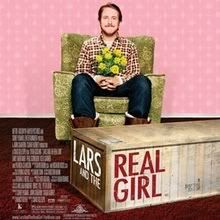
Lars and The Real Girl

Hey,

I just saw Lars and The Real Girl, with Ryan Gosling. I'm a huge Ryan Gosling fan and I've been waiting to see this movie for some time now. I give it a B+. I think Gosling's character, Lars, was very well played but the actions in the movie didn't ring true. Gosling did give a very good performance, as usual, but the storyline was weak.

It's obvious from the start that Lars is a damaged person. He doesn't like to be touched and he's detached from his family--apparently this is a result of early family tragedies. He is a functional being, with the ability to hold a job with very limited social skills. I will try not to give anything away that people can't get from the trailer or written reviews, but the first deviation from reality was when Lars actually ordered a man-made doll over the internet. It just doesn't seem within the character's ability to take such a proactive step in his attempt to find a companion/mate.

Several other things occur within the small northern town once Lars' companion, Bianca, arrives that also doesn't really mesh. I think it's great when people pull together to support those going through rough times, but even in a small town, resources (mostly financial) would definitely be an area of interest--but not in the movie.

The movie also touches on character--what it means to "be a man" and "do the right thing." This was probably the sweetest part of the film, but again, it was all just a little too simplistic and convenient. Now, even though I found several flaws with the movie, I would still recommend people see it. I think it does portray the nice and purposeful side of religion--to express tolerance, acceptance and a sense of community.

I do think Gosling put on a little weight for the movie, but I don't care--he's still hot. So, go see the movie--you'll like it. Plus, you'll get to see Ryan Gosling......who can knock that? In the meantime, I'll just be fantasizing about this being me:


Tuesday, October 23, 2007

If you sprinkle....

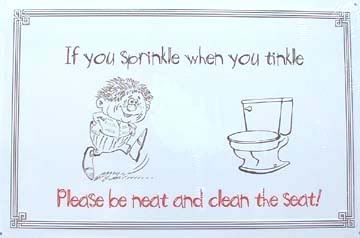
When I was growing up, my mom had a little framed print in the bathroom like this:

As a nine year old, I remember thinking how genius that little poem was.  Today, I wonder why that wasn't posted in everyone's bathroom.  I really think it should be a requirement.  It's funny how basic common sense is becoming more and more required public postings.

I mean, c'mon, ladies.  How do you leave a bathroom (public and/or private) stall with a dirty toilet seat?  Do you not think about wiping it off?  If so, why not?  Aren't you embarrassed when people enter the stall after you and will see the mess you've left?  Why not just wipe it off with toilet paper before you leave the stall?  Please help me understand.

Sunday, October 21, 2007

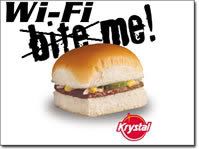
Meet me at the Krystal.......and bring your laptop

I'll have three cheese Krystals, some chili-cheese fries and a diet coke……oh, and some free Wi-Fi, please.  What's the deal with people eating extremely fatty food and then ordering a Diet Coke?  I digress.  My real concern is the free Wi-Fi.  Yep, here it is—Krystal (the fast-food joint) now offers free Wi-Fi.  So, instead of trying to find those nice, "sit-down" restaurants to hold those working power lunches with the business executives, just have everyone meet up at the local Krystal.  Or not.
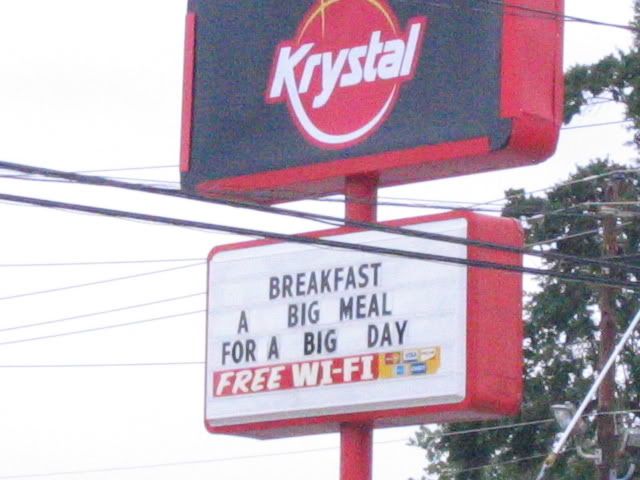
 

I have to say, when I first noticed the sign I didn't think much of it—so many places offer free WiFi now.  But then, I'd pass the sign several times a week and each time I saw it I found it more and more intriguing—then just pretty damn funny.  Why is it that a fast-food chain (that sells 59 cent hamburgers) can offer free WiFi as a service to its customers, but several hotel chains, airports, coffee shops, etc…, cannot—or does not, rather.  It seems a bit incongruous—dontcha think?

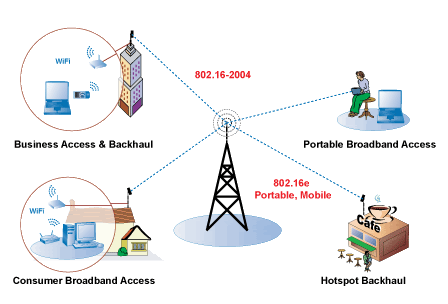
Yesterday, according to the New York Times, "The United Nations telecommunications agency in Geneva gave the upstart technology called WiMax a vote of approval. The International Telecommunication Union's radio assembly agreed late Thursday to include WiMax, a wireless technology that allows Internet and other data connections across much broader areas than Wi-Fi, as part of what is called the third-generation family of mobile standards.

That endorsement opens the way for many of the union's member countries to devote a part of the public radio spectrum to WiMax, and receivers for it could be built into laptop computers, phones, music players and other portable devices.

Unlike Wi-Fi, this mobile Internet technology can hand off a signal from antenna to antenna, thus allowing a device to hold a connection while in motion. WiMax potentially can move data at 70 megabits a second across 65 kilometers, or 40 miles. Current fixed-line broadband connections have speeds of about 2 megabits a second."

Doesn't it seem like we are behind the times, at times?  I mean, the technology to offer everyone completely wireless access to the internet exists.  It's there.  Because we live in a bureaucratic democracy, we have to first worry about regulation and establish so many vaguely written policies, to be challenged in court, before the people are given the "power" to access the world.  I think this is probably a measure to ensure the continuity of the middle class.  A democracy such as ours depends on the middle class to ensure its existence and viability.  The upper class doesn't have to worry about finance and policy and therefore are willing to pay a premium (literally and figuratively) to separate themselves from the rest of us.  But, again, I digress.

Just imagine how much free wireless internet access for all could benefit our capitalistic economy.  If internet access were free, how many purchases would be made by online shoppers waiting for their flight to board at the airport.  How many online movies would be downloaded, music purchased, etc, if people had all access all the time?  When people have to pay for mobile internet access, it reduces revenue because people have to either find hot-spots for their individual internet service provider (ISP), or they just don't bother.  But, again, due to the lack of regulations, free internet access for all is still a long ways away.  It seems as though the "Powers That Be" would be able to establish some sort of regs for ISP's that resemble the radio and TV stations.  WiMax might provide an outlet for this to occur—only time will tell.


I had a lot of ideas for this blog but due to lack of time and planning, I didn't get to shape my ideas into well-developed complete arguments.  I'll try to come back and do so as time permits, but in the meantime, lemme know your thoughts.  And, please change that Diet Coke into a chocolate milk shake, please.  If you're gonna splurge, do it right.  See ya at
Krystal.


Thursday, September 6, 2007

2 Days in Paris and then months and years and...

So, tonight I saw Julie Delpy's new flick 2 Days in Paris.  Overall, I guess the movie was pretty good.  It raises some age-old questions about life and love and how the two mix together, which are all pretty typical and not unlike other movies of the same genre, albiet the characters are more likely to be reversed.  However, to have written, directed, edited, starred in and everything else, Julie Delpy did an awesome job.

There is a typical introduction period at the beginning of the film that attempts to familiarize the audience with the characters and their two-year relationship.  This part of the film seemed a little too flat and forced to me, but an introduction is required, so that check box is marked.  Besides the flatness during the introduction was the fact that the characters weren't lovable.  Isn't it always great to fall in love with one, or both of the, characters and then follow along--leaving your heart crushed or euphoric by the end of the movie?  These characters were just regular people, nothing really too special about them, just a couple......maybe that was her point.  If that was her point, what do you think she might be saying?  That we idealize people (in Hollywood movies and in reality) and see things in them that don't really exist, or just think they exist until one day we wake up and realize that they don't and never did?  Just because we want things to be so doesn't really make them so, right?  Or, can it become a self-fulfilling prophecy?

For example, a nurse I used to work with (we'll call her Robin--mainly because that was her name) always seemed to live in this little fantasy world.  She was a 43 year-old divorcee with two grown children.  She was very good at managing her finances and actually was able to pay off her mortgage early and afford to buy her youngest son a slightly used car for about $12,000 in cash before he left for college.  Rarely do you see single parents in financial situations like that--especially since I knew the salary I was paying her.  But, despite her fiscal conservativism, she created a very elaborate world around herself.  She believed people were certain ways or carried particular characteristics because that is what she wanted them to be or portray.  When she spoke to others about these traits, and people disagreed with her or didn't see the same things as Robin saw, she would just laugh it off or say something like, "I know," as she giggled her way out of the conversation and the room.  The thing about it all, she was always so much happier than the rest of us--who actually lived in a shared common reality.

Scientists have found that when people are slightly depressed, they actually have a pretty good grasp on reality, whereas when they're happy or sad, their view tends to be slightly more skewed with optimism or pessimism, respectively.  Now, I in now way think that is an endorsement for trying to achieve a permanent state of mild depression just to maintain a firm grip on reality, because we actually need to be optimistic to move forward and make progress and, likewise, pessimistic to slow down and take note.  But I do find it kind of enlightening to know that we probably project certain personality traits and characteristics onto people and then believe they are like that.  When they do something that is incongruous with those traits we are disappointed and shocked.  Who's to blame here--them or us?

I have lots more to say on this topic but the hour groweth late and my eyelids becometh heavy so I will close.  What are your thoughts?  Do you think we actually accept and see people as they are, or as we want to see them, or as we want them to be?  Do you think this is something we've learned as members of society?  Are we conditioned to it, or is completely natural?  What about love?  Do you think love works the same way?  This was the major theme in the film.

Sunday, September 2, 2007

Shower Curtains and their rings

Okay, so you know how when you buy hot dogs, and there are like 10 hot dogs in a pack, but then when you get buns, there are only eight buns? Why do you think they can't work things out like the shower curtain makers and shower-curtain ring makers have been able to do? I mean, no matter where you buy shower curtains, there are always 12 slots for the rings. And, no matter where you buy the shower-curtain rings, there are always 12 rings to fit in each of the 12 shower-curtain slots. Now these are the type of complementary businesses that actually has the consumer in mind. If shower curtain makers and shower-curtain ring makers can work in tandem, then surely a lot of other businesses could do the same. Dontcha think?